How to Close a Candidate Who Has a Competing Offer
By the OnlyForRecruiters team
By the OnlyForRecruiters team · June 2026
Closing a candidate with a competing offer means guiding them to accept your offer when another employer is bidding for the same person. The fastest wins come from speed, a clear pitch on what your role offers beyond pay, and honest handling of the candidate's real priorities, not just matching the other number on the table.
That last part is where most recruiters slip. The competing offer feels like a salary problem, so they run to the hiring manager for more budget. Sometimes money is the issue. Often it isn't, and outbidding a rival offer you don't fully understand is how you win a candidate who reneges three weeks later.
Key takeaways
Move first. Speed is the single biggest lever you control, and competing offers punish slow processes.
Find out what the other offer actually is before you respond. You cannot beat an offer you haven't mapped.
Pay is one lever of several. Growth, manager fit, scope, and flexibility close candidates that money alone won't.
Know when to stop. A candidate pressured into a yes is a candidate who backs out.
What does it mean when a candidate has a competing offer?
A competing offer is any other live opportunity pulling at your candidate, whether that's a formal written offer from another company, a counteroffer from their current employer, or a late-stage process they're trying to finish before deciding. All three change your job from "sell the role" to "win a head-to-head."
This is common, not a crisis. Gartner found that more than a third of candidates received four or more offers during their last job search. If your finalist is any good, assume someone else is talking to them too.
Why do candidates end up with competing offers?
Strong candidates run parallel processes on purpose. They apply broadly, interview in batches, and time their decisions so offers land close together. That gives them leverage, and they know it.
The market reinforces the habit. Gartner research shows that even after accepting an offer, 47% of candidates said they were still open to other offers, and 42% believed they could find something better if they kept looking. Acceptance is not the finish line it used to be. A signature buys you a candidate's intent, not their loyalty, until they start.
For benchmarking, NACE's recruiting data puts the average offer-to-acceptance rate near 69%, which means roughly three in ten offers already get declined on a normal day. Competing offers are a big part of that gap.
What should you do in the first 24 hours?
Speed is the lever you most control, and it's the one slow teams waste. The moment a candidate mentions another offer, the clock is the competition.
Acknowledge it the same day. A fast, calm response signals the role matters. Silence signals the opposite.
Map the competing offer. Ask what the role is, the company, the comp shape, the start date, and their honest read on it. You need the full picture before you counter anything.
Get your decision-makers aligned fast. Brief the hiring manager and whoever controls budget that day, not next week. The candidate's deadline is real even when yours feels flexible.
Give the candidate a clear timeline. Tell them exactly when they'll hear back and from whom. Certainty is itself a closing tool.
How do you close a candidate without just raising the salary?
Matching a rival number is the easiest move and often the weakest. It teaches the candidate that pressure works, it can blow your bands, and it ignores why they were talking to other companies in the first place. The better play is to compete on the things money can't copy.
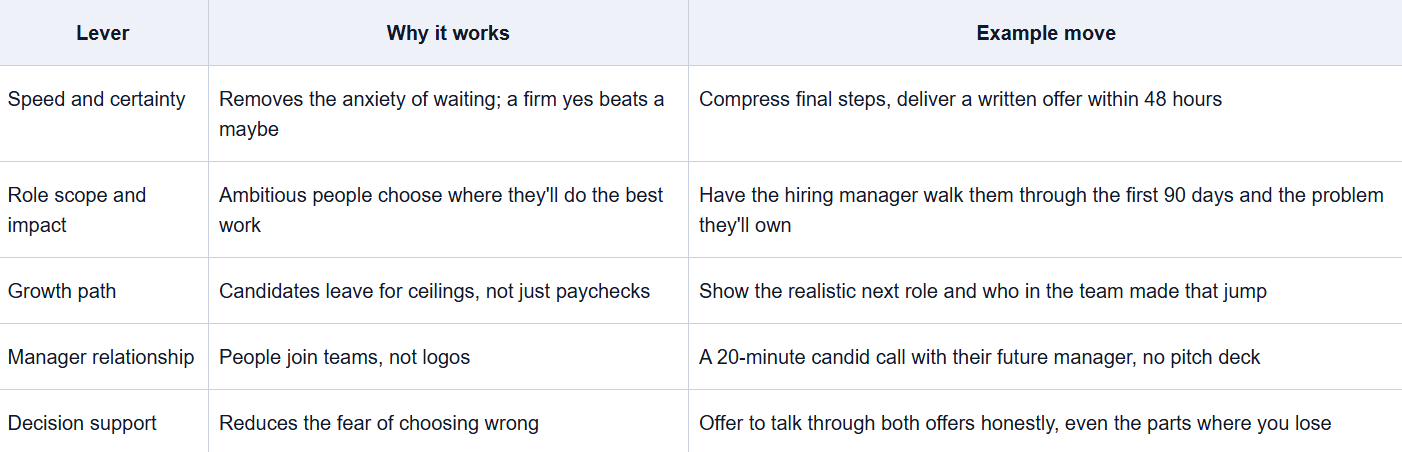
That last row surprises people. Offering to help a candidate weigh both offers, including where the other one is genuinely stronger, builds the trust that wins close calls. You don't win by hiding the comparison. You win by being the person who handled it straight.
What should you say when a candidate tells you about a competing offer?
Drop the panic and get curious. Your goal in the conversation is information first, persuasion second.
Try openers like these:
"That's great that you have options, you've earned them. Tell me what you're weighing between the two."
"Before I take anything back to the team, help me understand what would make this an easy yes for you."
"If the other offer didn't exist, would you take ours? I want to know if this is about money or about something else."
Then listen for the real driver. If they hesitate on the other company's manager or the scope, that's your opening, and it has nothing to do with salary. If it's purely comp and your band has room, you now have a specific case to bring back instead of a vague "they want more."
When should you walk away from a competing offer?
Not every candidate is worth winning, and a forced yes is the most expensive kind. Gartner found that half of the candidates it surveyed had accepted an offer and then backed out before their first day. A candidate you pressured past their real hesitation is a prime candidate to renege, leaving you to restart the search anyway.
Walk away, or hold firm without overbidding, when the gap is far outside your band, when they keep moving the goalposts after each concession, or when their reasons for wavering are really about doubts in the role itself. Stretching to win that person rarely ends in a hire who stays.
How do you stop competing offers from blindsiding you?
The best closing happens long before the offer stage. Two habits make competing offers far less dangerous.
First, understand the candidate's priorities from the very start. A thorough conversation up front tells you what actually matters to them, so a rival offer never catches you flat. Our guide to the recruiter intake meeting questions covers how to surface those drivers early, with the hiring manager and the candidate both.
Second, keep your process tight. Most candidates accept competing offers because someone else moved faster, not because the other role was better. Slow, silent stretches between stages are where you lose people. We break down exactly where that happens in why top candidates drop out before you make an offer.
FAQ
Should I always match a competing offer?
No. Match only when compensation is the real driver and the number fits your band. If the candidate's hesitation is about scope, growth, or their future manager, more money won't fix it and may set a precedent you regret. Find the actual reason first.
How fast should I respond to a competing offer?
Same day, ideally within hours. Competing offers come with deadlines, and slow responses read as low interest. Acknowledge immediately, then give a firm timeline for your full answer so the candidate isn't tempted to decide without you.
What if the competing offer is a counteroffer from their current employer?
Treat it carefully. Counteroffers often address pay but rarely fix why the person started looking. Ask what changed that made them job-search in the first place, and whether a raise alone resolves it. Many who accept counteroffers are job-hunting again within the year.
Is it unprofessional to ask about the other offer's salary?
No, if you frame it as helping them decide rather than gathering ammunition. Most candidates share the details when they trust you're trying to give them a fair comparison. You can't build a real counter to an offer you can't see.