What to Do When a Hiring Manager Rejects Your Candidates
By the OnlyForRecruiters team
By the OnlyForRecruiters team · June 2026
When a hiring manager keeps rejecting your candidates, the cause is almost always misalignment on what "qualified" really means, not bad sourcing. The fix is to stop sending more profiles and run a short recalibration instead: review the rejected candidates together, pin down the real must-haves, and rewrite the brief before you source again.
It feels personal after the third or fourth rejection. It usually isn't. A rejection streak is information. It's telling you that the picture in the hiring manager's head and the picture in the job description don't yet match, and every candidate you send into that gap gets caught in it.
Key takeaways
Rejections are feedback, not failure. They show you where the brief and reality drift apart.
Stop submitting after two or three rejections. More volume against a wrong brief wastes everyone's time.
Use the rejected candidates to recalibrate. The specific reasons they were turned down reveal the real criteria.
Sometimes the manager is the problem. Learn the signs, and learn to raise them the right way.
Why does a hiring manager keep rejecting your candidates?
Most rejection streaks come down to one of three gaps. The job description describes a role that no longer exists. The manager has an unspoken picture of the "right" person that was never written down. Or the must-haves and the nice-to-haves got blended into one long wish list, so everyone is screening against a different version of the role.
There's a useful signal here. Metaview's 2026 recruiting benchmarks set a healthy recruiter-to-hiring-manager pass-through rate at 30 to 50%. If the manager is rejecting almost everything you send, your pass-through is well below that, and that points to calibration, not candidate quality. The same benchmarks make a sharper point about interviews: when the interview-to-offer ratio climbs above six interviews per offer, the fix is rarely to be pickier at the offer stage. It's almost always necessary to tighten the screen upstream. In plain terms, the answer to "they keep rejecting people" is usually a better brief, not more candidates.
Example. A recruiter keeps submitting SaaS sales reps because the job description says "5+ years SaaS sales." Every rejection note says a version of "not enough enterprise experience." The real must-have, selling six-figure deals to enterprise buyers, was never written into the brief. The recruiter wasn't sourcing badly. They were sourcing to the wrong line.
How do you tell if it's a sourcing problem or an alignment problem?
These two problems look identical at a glance and require opposite fixes. Sourcing problems mean you can't find enough qualified people. Alignment problems mean you find plenty, and the manager rejects them. Mixing the two is how recruiters waste weeks.
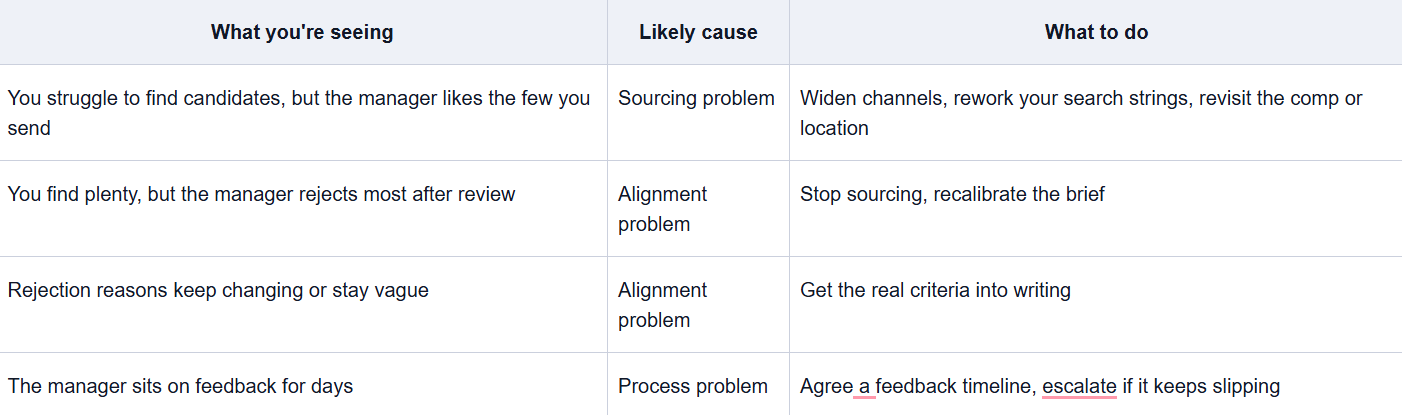
The tell is your own funnel. If candidates pass your screen but die at the manager's review, the break is between the two of you, not out in the market.
What should you do after the first two or three rejections?
Resist the urge to refill the top of the funnel. Pause and recalibrate. This is the single highest-value move, and most recruiters skip it because sending more candidates feels like progress.
Collect the specific rejection reasons in writing. Not "not a fit." Ask the manager what exactly ruled each person out.
Look for the pattern. Three vague rejections often share one real disqualifier once you line them up.
Ask the manager for 20 minutes to recalibrate. Frame it as helping you get them the right person faster, not as pushback.
Walk through two or three rejected profiles together. Let the manager point to what specifically failed on each.
Agree on the must-haves, separate from the nice-to-haves. The goal is a short list of true deal-breakers you both sign off on.
Re-source against the agreed brief. With the real criteria in hand, rebuild your search. Our complete Boolean search guide for recruiters walks through how to turn sharpened criteria into strings that actually surface those people.
How do you run a calibration that actually changes the brief?
Talking in the abstract gets you abstract answers. Real profiles get you real criteria. Share two or three actual candidates with the manager, ideally including one you think is borderline, and listen to how they react. Those reactions turn "I'll know it when I see it" into a list you can source against. You're not asking the manager to write a spec. You're giving them something concrete to respond to.
Example. A manager rejected several marketing candidates without a clear reason. Instead of sending more, the recruiter asked for fifteen minutes and brought two real profiles to talk through. As the manager explained what felt off about each one, it came out that they wanted someone who had owned a budget, not just run campaigns. That detail had never made it into the job description. One conversation surfaced what five submissions couldn't.
What do you say to a hiring manager who rejects everyone?
Lead with shared goals, not friction. You both want the role filled with the right person. Frame every ask around that.
Lines that work:
"I want to get you the right person fast. Could we look at the last three together so I can calibrate to exactly what you're after?"
"Help me understand the real deal-breaker here, so I stop bringing you people who miss on it."
"Here's what the market looks like for these must-haves. Can we talk through the trade-offs together?"
That last one matters when the criteria are unrealistic. You're not refusing or overruling anyone. You're showing the manager what their wish list costs and letting them make the call.
When is the hiring manager actually the problem?
Sometimes the brief is fine, and the manager is the bottleneck. Watch for a few signs. The criteria keep shifting after each round. They're holding out for a candidate who doesn't exist at the budget on offer. Or feedback simply doesn't come.
That last one is measurable. Metaview's 2026 benchmarks put a healthy time-to-stage at under seven days, and they name "awaiting hiring manager feedback" as one of the most common reasons candidates stall. When strong people sit for two weeks because feedback hasn't landed, you're losing them to faster competitors, and that's a process problem worth raising, not a sourcing gap.
Example. A recruiter found a strong engineer, but the manager wanted an extra year of Kubernetes experience at a salary band running well below market for that skill. Rather than push back in the abstract, the recruiter brought three recent salary data points to their next sync and walked through what that exact profile costs today. Seeing the numbers, the manager decided the extra year wasn't worth a much longer search and dropped the requirement. The role closed that month.
When a manager consistently rates candidates low and stays disengaged from calibration, that's worth a quiet word with your TA lead. It tends to show up in hiring manager satisfaction scores, too, where a healthy benchmark is an NPS of 30 or above. Persistent friction on one req is usually a relationship to repair, not a candidate pool to keep churning.
How do you stop this from happening in the next role?
Every fix above is a recovery move. The prevention is a real intake meeting before you source a single candidate. Agree on the must-haves versus the nice-to-haves, ask the manager for one concrete example of someone who would be a great hire, and set a feedback timeline you both commit to. Our guide to recruiter intake meeting questions covers exactly what to pin down so the brief and the manager's mental picture start aligned, rather than drifting apart three weeks in.
Do that well, and rejection streaks mostly disappear because you calibrated before sourcing rather than after five rejections.
FAQ
How many rejections should I accept before raising it?
Two or three. One rejection is normal. A pattern of three with vague or shifting reasons means the brief is wrong, and sending more candidates won't fix it. Pause and recalibrate before you waste more of your pipeline and the manager's time.
Should I keep sending candidates while we realign?
No. Pause submissions until the brief is rewritten. Sending more profiles against criteria you both know are unclear just produces more rejections, erodes the manager's confidence in you, and burns good candidates on a role that isn't ready for them.
What if the hiring manager won't meet to recalibrate?
Put the criteria in writing and ask them to confirm or correct it, which is lower effort for them than a meeting. If they still won't engage and the role stalls, raise it with your TA lead. A req that can't move because feedback isn't coming is a leadership issue, not a recruiting one.
Is it ever just the candidates' fault?
Occasionally, a single candidate genuinely misses. But a pattern of rejections almost always points to the brief, not the people. If you can find these candidates and your screen passes them, the disconnect is between the job description and what the manager actually wants.