Role Open Too Long? How to Find Your Hiring Bottleneck
By the OnlyForRecruiters team
By the OnlyForRecruiters team | Published August 2026
This article is for in-house recruiters and talent acquisition teams carrying at least one requisition that has aged past the point where anyone still asks about it in standup.
Every recruiting team has one. The req nobody mentions in the weekly meeting anymore. It has a pipeline, it has interviews on the calendar, and it has been open since April. The usual response is to source harder, which almost never works, because the candidates were never the problem. The hiring bottleneck is somewhere inside your own process, and it is usually not where people assume. This article shows you how to locate it in five measurements.
TL;DR
A role open 90 days is not automatically a broken role. Senior positions take 37% longer to fill than junior ones, and technical roles run about 15 days longer than business roles (Ashby, 2026).
Aged requisitions rarely have one big cause. Ashby's analysis of 54 million applications found that time-to-hire is driven by many small delays across every stage, not a single bottleneck.
The fastest way to unstick a role is to measure five checkpoints against published 2026 benchmarks and find the one where your numbers fall off a cliff.
The two checkpoints that most often hide the problem are the gap between the final interview and the hiring decision, and the recruiter screen passthrough rate.
If every checkpoint looks normal and the role is still open, the problem is upstream in how the role was defined, not in the funnel.
What is a hiring bottleneck?
A hiring bottleneck is any stage in your recruiting process where candidates accumulate faster than they move out. It is a process problem, not a market problem. The test is simple: if candidates are entering the stage and not leaving it at the expected rate, that stage is the bottleneck, regardless of how busy everyone in it feels.
This is different from a role with no candidates at all. A stuck role is a requisition where candidates stop progressing rather than one where candidates never arrive. The distinction matters because the two problems have opposite fixes. A role with no applicants needs sourcing. A role with 400 applicants, six screens, two onsites and no offer has a decision problem. Most requisitions that are 90 days or older belong to the second group. They have pipeline. What they lack is movement through it.
Why do roles stay open past 90 days?
Three things changed at once, and they compound.
Recruiters are handling 93% more applications than in 2021 while carrying 13.4 open roles at a time, according to Gem's 2026 Recruiting Benchmarks Report, which covers 165 million applications and 1.2 million hires. Recruiting headcount is down 14% against 2021. At the same time, the average number of interviews per hire has risen 33% since 2021.
More volume, fewer people, longer processes. A req that would have closed in six weeks in 2021 now competes for attention against twelve others and passes through more hands before anyone can say yes.
That is the environment. It is not an excuse for a role sitting at day 97. It does explain why the old advice, which was usually some version of "source harder," rarely moves an aged req anymore. The candidates are already in the pipeline. Something is holding them there.
How do you tell a stuck role from a slow one?
Before diagnosing, check whether the role is actually behind. Applying one time-to-fill target across every function makes technical and senior hiring look broken when it is running normally.
Adjust your expectation using these two findings from Ashby's 2026 Recruiting Operations Benchmarks, based on 54 million applications and 93,000 jobs from January 2021 through March 2026:
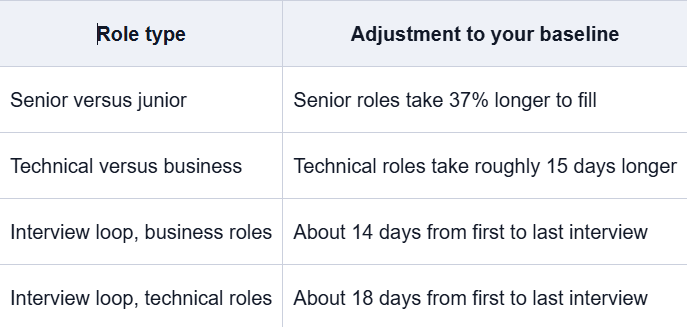
A senior technical role at day 90 may be tracking to plan. A junior business role at day 90 is not. Set the baseline before you set off alarms.
Does the bottleneck sit before the job was even posted?
Check this before running the funnel diagnostic, because the five checkpoints below only measure what happens after a candidate applies. If the delay happened upstream of that, the funnel will look healthy while the req still ages.
Measure two gaps from your own records:
Days from headcount approval to job posted live
Days from posting live to first candidate reviewed
Both are invisible in time-to-hire, which starts counting when a candidate enters the pipeline. A req can burn three weeks in approval chains and rewrites and still report a respectable time-to-hire, because the clock had not started.
I have not found a benchmark for either gap published by a named primary source, so treat these as internal baselines rather than industry comparisons. Track them across your own last ten reqs and use the median as your reference. If the aged req is well above your own median, the bottleneck is in approvals, and the rest of this diagnostic will not find it.
Where is the hiring bottleneck? A five-checkpoint diagnostic
Pull the pipeline for the aged req and calculate these five numbers. Compare each against the 2026 benchmark. The checkpoint where your number falls furthest below the benchmark is where the role is stuck.
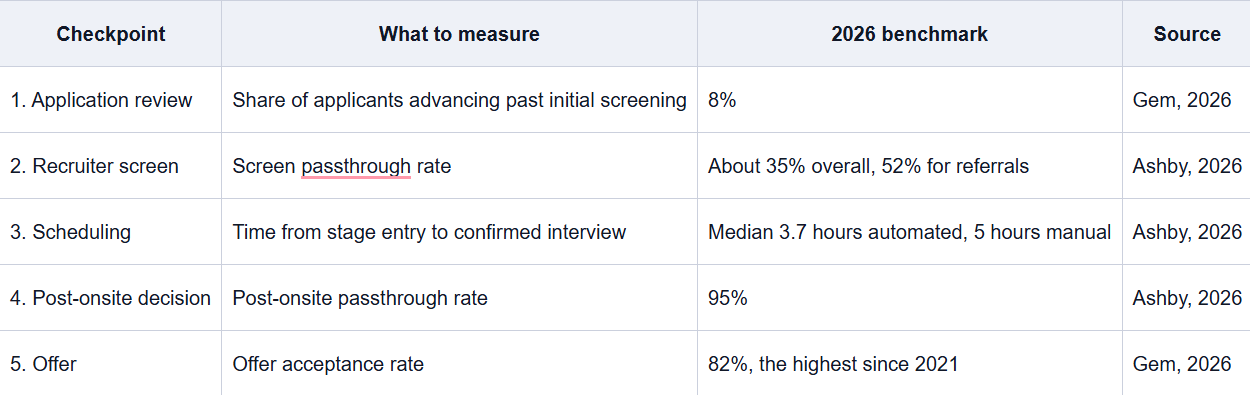
Full-funnel context: across Gem's data, 0.5% of applicants receive an offer, roughly one hire per 200 applications.
Checkpoint 1: Application review
If far fewer than 8% of applicants advance past the initial screening, the role is filtering too hard at the top. This usually means the requirements list is longer than the job. It can also mean review has simply stalled, with applications sitting unread because the recruiter is triaging twelve other reqs. Ashby identifies application review as the first point of delay, and the gap between fast and slow companies at this stage is wider for technical roles than business roles.
Checkpoint 2: Recruiter screen
A screen pass-through far below 35% means candidates are reaching you who should never have been in the pipeline, or your screen criteria and the hiring manager's criteria are different documents. Referred candidates pass initial screens at 52%, compared to 35% overall, so a req with no referrals will naturally run at the lower end.
Checkpoint 3: Scheduling
Ashby separates scheduling into two clocks: how fast a schedule goes out, and how far out the interview lands. Lead time is the bigger drag. Interviews get booked quickly, then sit 10 days out because two panel members share one open slot. Automated scheduling confirms interviews 26% faster than manual scheduling, with a median of 3.7 hours versus 5. On a five-stage loop, that difference alone compounds into a week.
Checkpoint 4: Post-onsite decision
This is the checkpoint most teams never measure, and it is where aged reqs usually die. Post-onsite pass-through is 95%, so if candidates are reaching your final round and not converting, something is wrong with calibration rather than candidate quality. Ashby found that the time between the final interview and a hiring decision is one of the most significant sources of delay in the whole process, and that about 38% of scorecard pairs contain at least one point of disagreement between interviewers. Nearly half of those one-point gaps sit between 2 and 3 on a 1 to 4 scale, which is the line between yes and no. Every one of those triggers another conversation, and another week.
Checkpoint 5: Offer
Offer acceptance now sits at 82%, the highest since 2021. If your aged req has produced two declined offers, the problem is compensation, timeline or the closing conversation, not the market. Two declines against an 82% baseline is a signal worth acting on.
What do you do once you know where it is stuck?
Fix one checkpoint at a time and re-measure. Changing four things at once tells you nothing about which one worked.
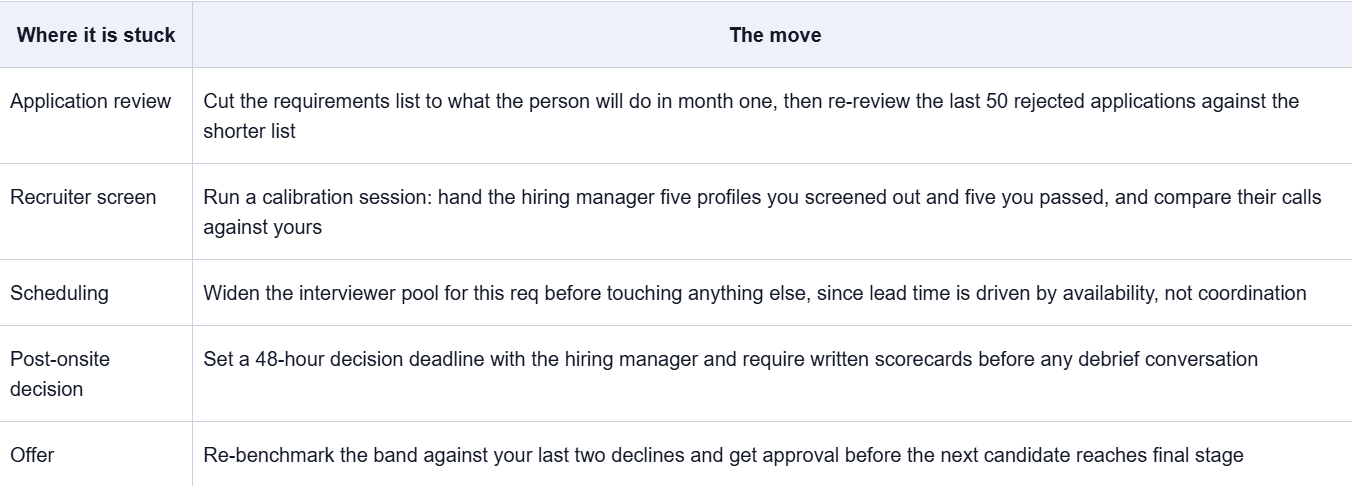
The rediscovery route is worth a mention here. Nearly half of sourced hires, 46%, now come from candidates already in the company's CRM or ATS, up from 26% in 2021. Before opening a new sourcing campaign on a 90-day req, work the silver medalists from the last two similar roles.
What if the funnel looks fine and the role is still open?
Then the role was never properly defined, and no amount of pipeline will fix that.
The signals are easy to spot once you look for them. The hiring manager rejects candidates without a pattern you can articulate. The must-have list changes between conversations. Two people on the panel describe the job differently. When that is happening, the diagnostic to run is not a funnel audit but a re-intake.
This is the same failure that shows up when a hiring manager keeps rejecting candidates, and it is usually a definition problem rather than a sourcing one. Our guides on what to ask in a recruiter intake meeting and what to do when a hiring manager keeps rejecting your candidates cover the questions that surface the real requirement.
There is a second upstream possibility worth ruling out. If candidates are entering the pipeline and then disappearing before you can put an offer together, the req is not stuck so much as leaking, and that is a different repair job. Our breakdown of why top candidates drop out before you make an offer covers where in the process that usually happens.
A re-intake on a 90-day req is not an admission of failure. Details change over three months. Budget shifts, the team reorganises, the person who would have done half this job leaves. Treat the original intake as expired.
How do you stop reqs from ageing in the first place?
Build a weekly check on the two numbers that predict ageing before it happens: days in current stage for every active candidate, and days since last candidate movement for every req.
Any req with no stage movement in 14 days goes on a review list. Any candidate sitting at one stage for more than a week gets a forced decision or gets closed out. This second habit matters beyond the req itself. Ashby found that non-interviewed candidates archived within one day have a median NPS of 9, falling to 7 between days 10 and 24 and to 3 after 50 days. Around 58% of non-interviewed candidates are archived within 9 days, but there is a visible spike at 150 days and beyond, where candidates who fell through the cracks end up.
Those forgotten candidates are the same people you will want to rediscover for the next req, so closing them out properly counts as sourcing work.
The stuck req worksheet
Copy this into a doc and fill it in for the aged requisition before your next conversation with your hiring manager. It takes about fifteen minutes with the ATS open.
REQ: ______________________  Days open: ______
Function: business / technical     Level: junior / mid / senior
Adjusted baseline (senior +37%, technical +15 days): ______ days
Behind baseline? YES / NO

CHECKPOINT              OURS      2026 BENCHMARK    GAP
1. Past initial screen  ____%     8%                ____
2. Screen passthrough   ____%     35% (52% ref)     ____
3. Stage-to-interview   ____hrs   3.7h auto / 5h    ____
4. Post-onsite pass     ____%     95%               ____
5. Offer acceptance     ____%     82%               ____

Largest gap is checkpoint: ______
Owner of that checkpoint: recruiter / hiring manager / approval chain
One change we are making this week: ______________________
Re-measure on (date): ______
Fill only the gap column before deciding anything. The checkpoint with the widest gap is the conversation to have. The others can wait until the next cycle.
Frequently asked questions
What is a hiring bottleneck?
A hiring bottleneck is a stage in the recruiting process where candidates enter faster than they exit. Common locations are requisition approval, application review, interview scheduling, post-interview feedback, and offer approval. The bottleneck is identified by measuring passthrough rate and time in stage against benchmarks, not by asking where people feel busiest.
How long should a role take to fill in 2026?
There is no single number that works across functions. Ashby's 2026 data show senior roles taking 37% longer than junior roles, and technical roles taking about 15 days longer than business roles. Set separate baselines by seniority and function, then measure each req against its own baseline rather than a company-wide target.
Is a role open 90 days a recruiter problem or a hiring manager problem?
Run the five-checkpoint diagnostic before assigning it. Delays in application review and screen pass-through usually stem from the recruiter or the requirements list. Delays in post-onsite decision-making and offer approval usually rest with the hiring manager or the approval chain. The data tells you which conversation to have.
What is a normal recruiter screen pass-through rate?
About 35% overall, according to Ashby's 2026 benchmarks. Referred candidates pass initial screens at 52%. A req running well below 35% with no referrals in the pipeline points to a mismatch between what you are screening for and what is reaching you.
Should I close a req that has been open too long?
Closing and reposting resets the clock without fixing anything, and it costs you the candidates already in process. Close a req only when the underlying business need has changed. If the need is real, re-intake and fix the blocked checkpoint instead.
How many open roles should one recruiter carry?
Gem's 2026 benchmark puts the average at 13.4 open roles per recruiter, alongside 93% more applications than in 2021. If you are carrying meaningfully more than that, req ageing is a capacity problem, and the fix is triage rather than diagnosis.
Does adding more candidates fix an aged requisition?
Rarely. Most reqs from the past 90 days have pipeline but lack decisions. Gem's data show that 0.5% of applicants receive an offer, so adding another 100 applications yields fewer than 1 additional offer on average. Fixing a stalled decision produces one immediately.