Too Many Job Applicants? How to Filter Out AI Spam Without Losing Good Candidates
By the OnlyForRecruiters team
By the OnlyForRecruiters team | Published September 2026 | Last updated: September 2026
TL;DR: Application friction is any deliberate step that makes applying take more than one click, like knockout questions or a short written answer. Recruiters with too many job applicants are adding it back because applications per hire have tripled since 2021, to more than 300 on average, according to Ashby. Done well, a few short questions cut AI-generated junk without scaring off good people. Done badly, you lose the candidates you wanted.
You post a role on Monday. By Wednesday, there are hundreds of applications, many of them read as if written by the same person, and a few list experience that doesn't add up. You haven't spoken to a single candidate yet.
If that sounds familiar, you're not alone, and you're not bad at your job. There are too many job applicants for any recruiter to review properly, and the old advice (make applying as easy as possible) is part of the reason. More recruiters are now trying to reduce the number of unqualified applicants before they ever reach the inbox. This article is for in-house recruiters and TA teams who spend more time clearing application inboxes than talking to people.
In this article
Why are there too many job applicants right now?
What is application friction?
Why are recruiters adding friction back to job applications?
Which types of friction filter out AI-generated applications?
When does application friction backfire?
How do you reduce unqualified applicants without losing good candidates?
Copy-paste knockout question template
Is LinkedIn doing anything about the flood?
FAQ
Why are there too many job applicants right now?
Applications per hire have tripled since 2021, reaching more than 300 on average, according to Ashby's May 2026 analysis of more than 100 million applications. Two trends happened over the same period, though WIRED, which reported both, doesn't claim one caused the other. First, applying got much easier. AI tools can write tailored resumes and cover letters in seconds, and browser extensions can automatically fill out entire applications. LinkedIn told WIRED in August 2026 that submissions per applicant on its platform are up 46% compared to February 2020. Second, there are fewer jobs to apply for. US job openings peaked at 12.3 million in March 2022 and have hovered around 7 million since mid-2024, based on Bureau of Labor Statistics data. Andrew Stockwell, former head of people at Vendr, told WIRED he used to review up to 100 applications for a role. In the past year or so, a posting could bring in hundreds within a day or two, and at times more than 1,000.
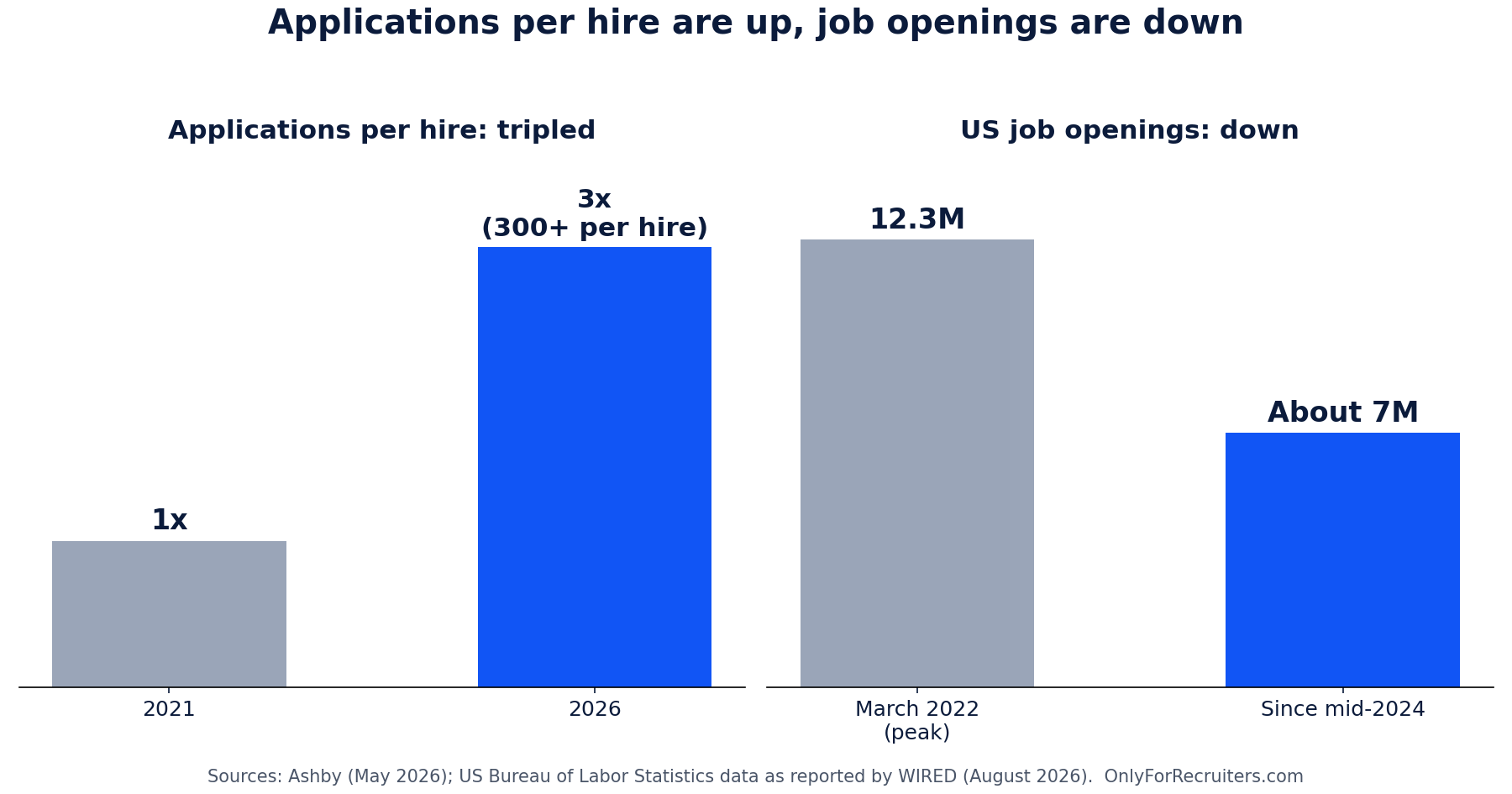
Applications per hire are up, and US job openings are down. Sources: Ashby (May 2026); Bureau of Labor Statistics data as reported by WIRED (August 2026).
Stockwell said a good share of those applications were fake candidates or resumes stretched by AI. That's the part that hurts most. The volume is high, and a lot of it isn't real.
What is application friction?
Application friction is any step that makes applying take more effort than a single click. Examples include knockout questions, a short written answer about the role, or applying through the company's career site instead of a one-click button. Recruiters add it on purpose to filter out low-effort and automated applications.
For years, the standard advice was the opposite: remove every step, because every extra field can lose candidates. That advice made sense when roles got far fewer applicants. It makes much less sense when a single hire takes more than 300 applications.
Why are recruiters adding friction back to job applications?
Recruiters are adding friction back because screening hundreds of AI-generated applications now eats the time they should spend talking to candidates. Ophir Samson, who leads voice AI at Greenhouse, told WIRED that a year ago recruiters wanted the smoothest possible applicant experience, and what they got was 2,000 applicants in 24 hours for one job. Now recruiters tell him, "We kind of want friction. The friction is good." He also said recruiters often tell him they have 1,000 applications and know only about 30 of them are serious.
The cost shows up in two places. The first is recruiter time. Stockwell described paying experienced TA professionals to look through applications all day instead of finding and talking to candidates. The second is the candidates themselves. Ashby's data, reported by HR Dive, shows candidates are about 50% less likely to reach the interview stage than they were five years ago. Good people are still in the pile. They're just buried.
We think the shift is the right call, with one warning. Friction is a filter, and a badly built filter catches the wrong people.
Which types of friction filter out AI-generated applications?
The friction that works best costs a real, interested candidate about a minute and costs a mass-apply tool enough that it skips your posting. In our view, knockout questions and one short role-specific question fit that best. Long forms and early unpaid assignments are a poor fit, because they cost honest applicants more than bots. Here's how the common options compare.
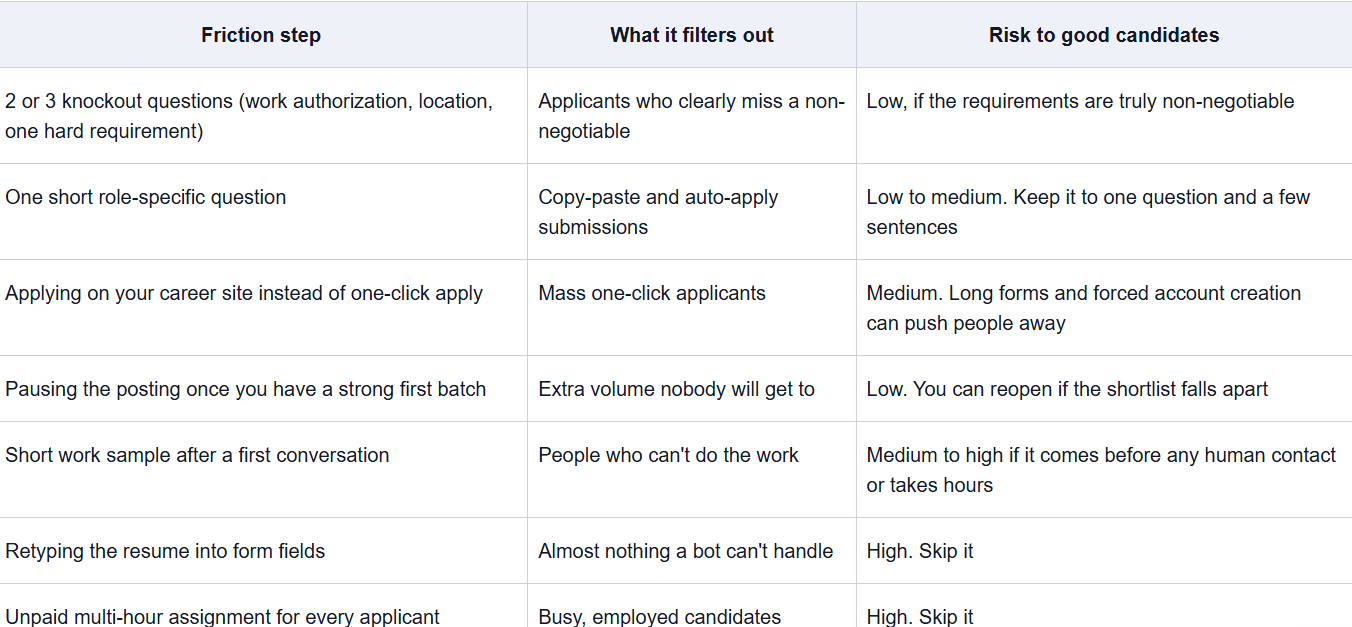
One more option if inbound is hopeless for a role: spend the screening hours on outreach instead. Our Boolean search guide for recruiters covers how to find people who never applied.
When does application friction backfire?
Application friction backfires when it costs strong, busy candidates more effort than it costs mass-apply tools. Here are three ways that happens.
It penalizes people who already have jobs. A strong candidate who's employed has less patience for a long form than someone firing off 100 applications with a tool. If your steps take 20 minutes, you end up filtering for free time, not quality. Long, unclear processes can also push candidates to quit partway, which we covered in why top candidates drop out before you make an offer.
It can shrink your pipeline to people you already know. WIRED reports the flood has pushed recruiters back toward referrals and internal hires. Stockwell told WIRED this has a cost: hiring that relies on referrals favors candidates whose backgrounds resemble those of people already inside the company, which works against building a diverse team. SocialTalent went further, arguing that relying on referrals means giving up on judging outside applicants well, rather than getting better at it. If friction is your whole strategy, your pipeline can start to look like your current team.
And AI can answer questions too. A written question stops lazy auto-apply tools, but a determined applicant can paste it into ChatGPT. Friction cuts volume. It doesn't replace screening.
How do you reduce unqualified applicants without losing good candidates?
Add the smallest amount of friction that removes the obvious mismatches, then screen the rest carefully. In practice, that means two or three knockout questions, one question tied to the actual role, and a short form. Here's the process step by step.
Agree on the true must-haves at intake. Knockout questions only work if the hiring manager has committed to what actually rules someone out. These recruiter intake meeting questions help you get that answer before the role goes live. If the list keeps changing later, see what to do when a hiring manager keeps rejecting your candidates.
Add two or three knockout questions at most. Work authorization, location or on-site days, and one hard requirement. If a "wrong" answer wouldn't actually disqualify someone, delete the question.
Write one question only someone who read the posting can answer. Tie it to something specific in the job, like a project or a tool the team uses. Ask for a few sentences, not an essay.
Keep everything else short. Resume upload plus your questions. Skip forced account creation if your ATS lets you.
Set a volume trigger before you post. Decide upfront that you'll pause the posting once you have enough qualified applicants for a first review.
Screen what gets through properly. Fewer applications doesn't mean every one is genuine. Our guide on how to screen candidates when every resume looks AI-perfect covers the signals that still hold up.
Check your completion rate after two weeks. If your ATS or career site tracks how many people start an application compared to how many finish, compare the numbers before and after the change. If a new question causes a sharp drop, rewrite it or cut it.
Copy-paste knockout question template
Use this as a starting point and edit the brackets for each role.
Knockout questions (yes/no or multiple choice)
Are you authorized to work in [country] without sponsorship now or in the future? (Yes / No)
This role is [on-site / hybrid, X days a week / remote] based in [location]. Does that work for you? (Yes / No)
This role requires [one hard requirement, for example: a current nursing license in Texas / 3+ years managing payroll for 500+ employees]. Do you have this? (Yes / No)
Role-specific question (short text, 2 to 4 sentences) 4. In the first 90 days, this person will [specific task from the job description]. Tell us about a time you did something similar, or how you'd approach it.
Rules for using it
Only mark questions 1 to 3 as automatic disqualifiers if the hiring manager signed off at intake.
Read question 4 as a signal, not a test. Specific, relevant answers beat polished ones.
Remove any question your completion rate shows is scaring off applicants.
Is LinkedIn doing anything about the flood?
Yes, but only on its own platform. WIRED reports LinkedIn has added limits aimed at automated, low-quality applications. In August 2026, it also began rolling out a feature that warns applicants who look underqualified that they probably aren't a good fit, and suggests other roles.
That helps, but don't build your process around it. It only covers LinkedIn, so your career site, Indeed, and every other channel still need their own filters.
The short version
When you have too many job applicants to read them all carefully, waiting for the volume to drop isn't a plan. Adding friction on purpose is a sensible response, as long as each step removes more junk than good candidates. Pick your highest-volume open role this week, add the knockout questions from the template above, and compare applicant quality and completion rate two weeks later.
FAQ
What is application friction in recruiting?
Application friction is any deliberate step that makes applying take more than one click, such as knockout questions, a short written answer, or applying through a career site. Recruiters use it to cut automated and low-effort applications, so they can spend their time on candidates who are actually interested and qualified.
How many applications does a job get in 2026?
Ashby measures applications per hire rather than per posting. Its May 2026 analysis of more than 100 million applications found applications per hire have tripled since 2021, to more than 300 on average. Volume varies by role, location, and whether the posting uses one-click apply, so your own ATS data is the best benchmark for your team.
Why are job applications flooded with AI-generated resumes?
AI tools can write a tailored resume and cover letter in seconds, and browser extensions can fill out whole applications with no human involved. LinkedIn says submissions per applicant are up 46% since February 2020. At the same time, US job openings are far below their March 2022 peak, so more applications are competing for fewer roles.
How do I handle too many job applicants for one role?
Pause the posting once you have enough qualified applicants for a first review, then add two or three knockout questions and one role-specific question before reopening. Screen the existing pile against must-haves the hiring manager agreed on at intake, so every application is judged the same way.
Should recruiters turn off LinkedIn Easy Apply?
It depends on the role. For roles that attract hundreds of unqualified applicants, sending people to your career site with a few knockout questions can cut volume. For senior or hard-to-fill roles, one-click apply can still help. Test it on one role first and compare applicant quality, not just the count.
Does adding friction hurt candidate experience?
It can, if the steps are long or feel pointless. Short questions that clearly relate to the job are the safer choice. Avoid busywork like retyping a resume into forms, and unpaid multi-hour tasks before anyone has spoken to the candidate. Pair friction with fast replies to people who make it through, so the extra effort feels worth it.